


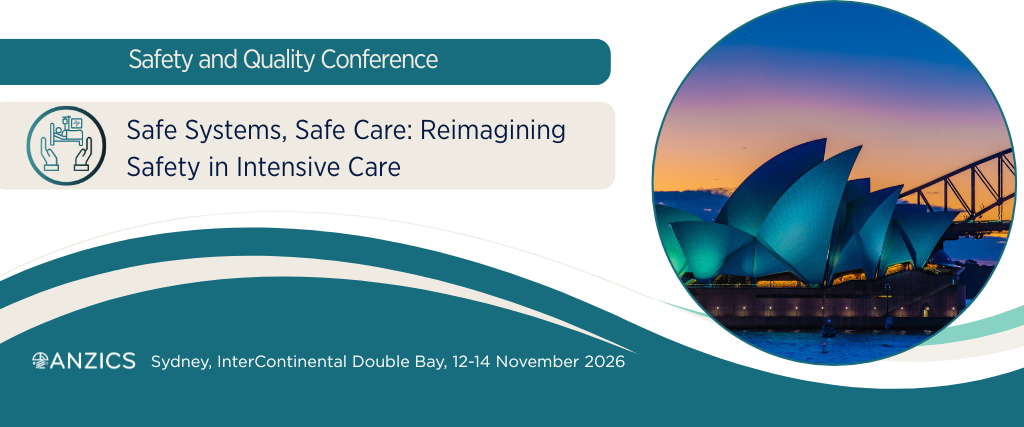
Event Information |
Program & Abstract Guidelines |
Registration |
Sponsors & Exhibitors |
Workshops |
Conference Schedule
Thursday, 12 November 2026
- 07:45 – 08:30 | Registration
- 08:30 – 17:56 | Conference Program
- 18:00 – 20:00 | Welcome Reception
Friday, 13 November 2026
- 07:45 – 08:30 | Registration
- 08:30 – 17:35 | Conference Program
Saturday, 14 November 2026
- 08:00 – 09:00 | Registration
- 09:00 – 15:00 | Workshops
Program Highlights:
Eight critical themes addressing the real‑world challenges facing intensive care teams today:
- Sepsis – improving early recognition and patient outcomes
- Equity – designing fairer, more inclusive ICU care
- Organisational culture – enabling safe, high‑performing systems
- Cardiovascular mechanical support – advancing complex ICU care
- Staff wellbeing – supporting a sustainable workforce
- Delirium – improving prevention, detection, and management
- Consumer engagement – partnering with patients and families
- Team culture – strengthening collaboration and psychological safety
Abstract Submission Guidelines:
Abstract Submissions are now open!

Please read the guidelines below carefully. Abstracts not submitted in this format may not be considered for review. If you have any difficulties or queries about the abstract format, please contact the following email anzics@anzics.org
- Abstract Submissions will open on 11 May 2026
- Only abstracts submitted in English will be reviewed.
- Abstracts are to be submitted in Microsoft Word format (.doc or .docx) using the format below.
- Completed abstracts should be submitted by 24 July 2026, 11:59 pm.
- You will receive a confirmatory email notifying you that we have received your abstract.
- Abstracts must have a maximum of 400 words. Word count does not include title or address; all numbers are included in the word count. Word count is verified using Microsoft Word.
Abstracts should not have been published in any English language peer reviewed journal, and in general should not have been presented at more than one meeting from which such publications arise. Studies with substantial changes in methodology and/or with substantial additional data may be submitted, presented and published a second time, but rewritten abstracts on the same study should not.
Abstract headings shall contain the following:
- Title of the presentation.
- Author(s) name(s) (title, first name, surname). List the name of the lead/presenting author first.
- Institution(s), state and country of origin.
Abstracts shall contain brief but complete statements of:
- Introduction
- Objectives
- Methods
- Results
- Conclusion(s)
- The text should not contain statements alluding to results or conclusions not presented in the text. Abstracts stating, “will be discussed”, “will be described” or “will be presented” will be rejected.
- Abstracts should be written in the past tense, stating what was done, rather than what is being, should or will be done.
- Use only standard abbreviations (“Uniform Requirements for Manuscripts submitted to Biomedical Journals”). Nonstandard abbreviations should be kept to a minimum and defined in parentheses in the text. In general, no more than 2 nonstandard abbreviations should be used and should only be used to replace words appearing 4 times or more in the text.
- Use International System of Units except for pressure; use cmH2O or mmHg with kPa units in brackets (optional).
- Abstracts may contain one simple table, graph or diagram.
- Acknowledgment of supporting institutions may be made at the end of the text.
- References are not to be included.
Abstracts received after the closure date will not be accepted.
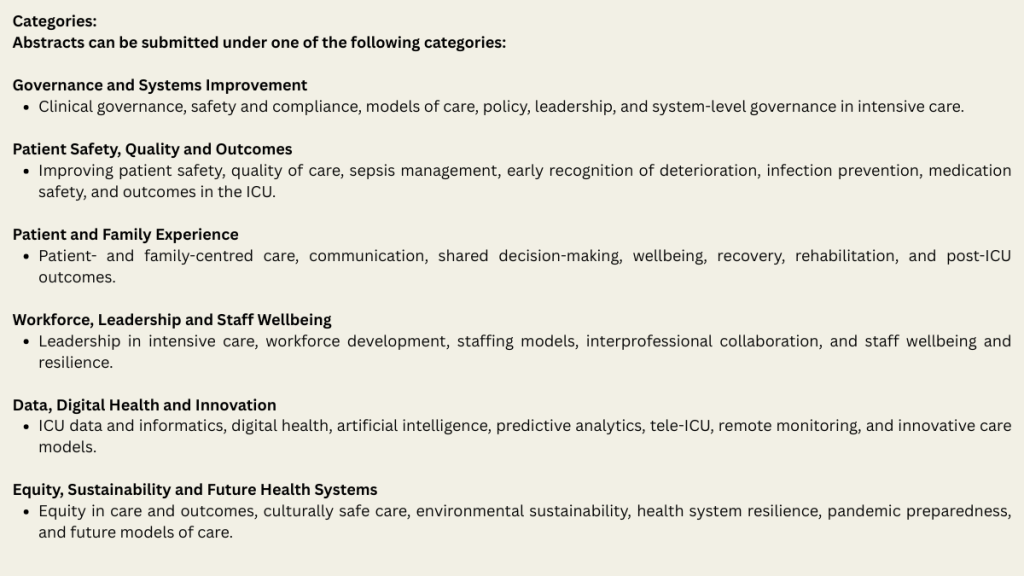
Oral Presentations
- Oral presentations are expected to be delivered in person and limited to 8 minutes, inclusive of Q&A.
- Presentations must be provided in PowerPoint format.
Judging
A maximum of 40 presenters will be invited to submit their talk to be part of the main program, based on the judge’s assessment of the quality of the presentation.
All Free papers will be judged on abstract quality, methodological merit, work involved, standard of presentation and question handling, relevance, and originality.